
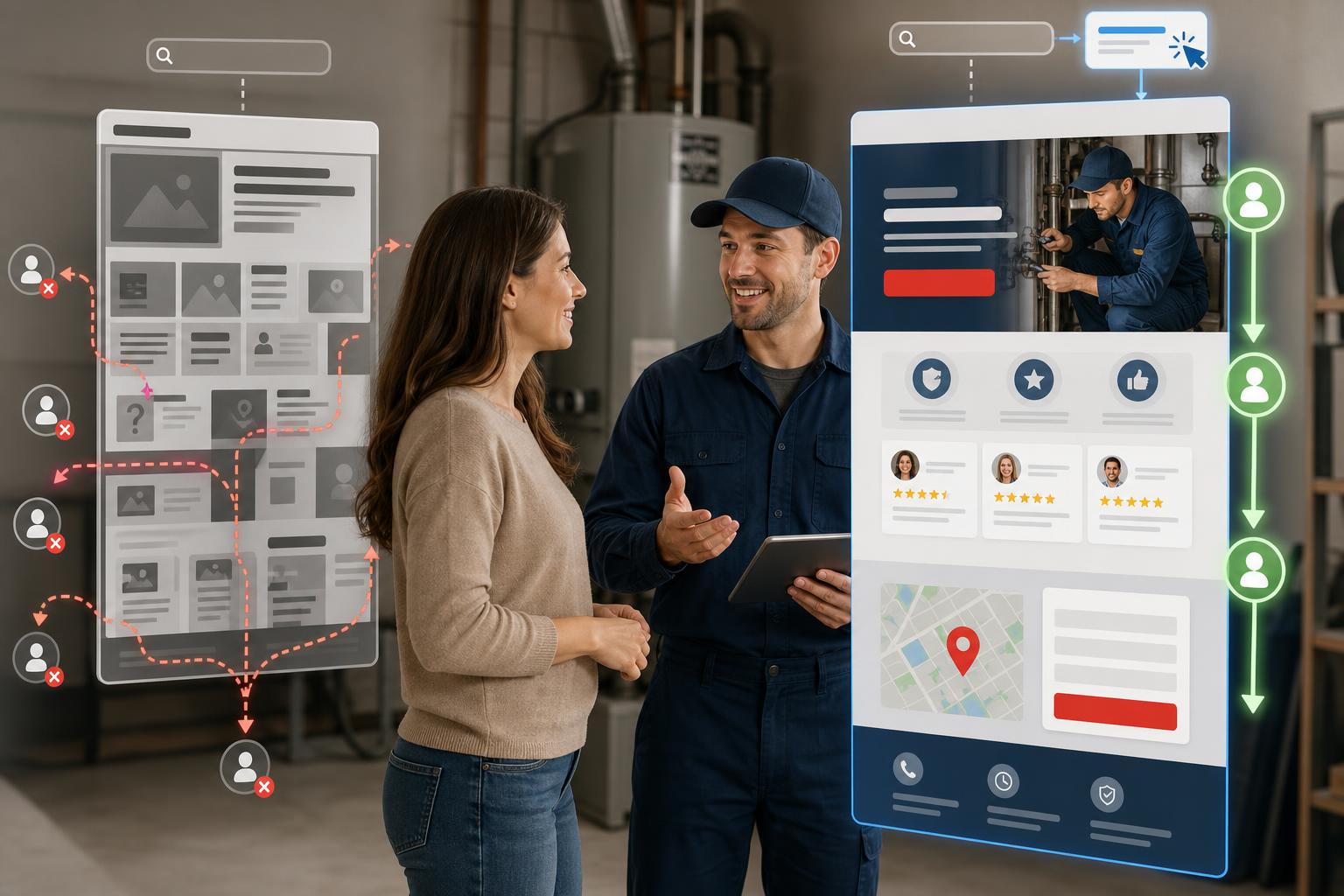
Many small businesses do the hard part first: they invest in Google Ads, improve their local visibility, or publish service pages that start bringing in traffic. Then the disappointing part happens. People click, browse for a few seconds, and leave without calling, booking, or filling out a form.
In most cases, the problem is not a total lack of demand. It is a mismatch between what the visitor expected to see and what the page actually delivered. Someone searching for a specific service, in a specific area, with a specific need usually responds better to a focused landing page than to a general homepage or a broad all-purpose services page.
That gap matters because more traffic does not automatically mean more leads. If the page is too broad, too distracting, or too vague, even qualified visitors can lose momentum. For Toronto and GTA small businesses trying to get more value from paid traffic or local search, this is often one of the biggest hidden leaks in lead generation.
At nuBranch Media, this is one of the first things we review when a business says, “We’re getting clicks, but not enough calls.” The traffic source matters, but the destination page often matters just as much. A better page structure can improve lead quality and conversion rate without immediately increasing ad spend.
Key Takeaways
- High-intent landing pages work because they match the visitor’s exact need more closely than a homepage.
- Message match between the ad or search query and the page content reduces confusion and drop-off.
- Strong local offers, visible trust elements, and a clear next step can increase calls and form fills.
- Pages should be built around intent, not just around what the business wants to say about itself.
- Better conversions often come from a more focused page experience, not just more traffic.
What makes a landing page “high intent”?
A high-intent landing page is built for a visitor who already knows roughly what they want and is deciding whether your business is the right fit. They are not in early research mode. They are closer to taking action.
That means the page should reflect a narrow purpose. Instead of trying to explain your entire company, it should answer the specific question the visitor brought with them.
For example, a homepage may talk about your team, your services, your process, your reviews, your latest blog posts, and your service areas all at once. That can be useful for general brand discovery. But if someone clicks an ad for emergency plumbing in Scarborough, a homepage asks them to do too much work. They have to search for the right service, confirm the area served, evaluate trust, and figure out how to contact you.
A high-intent landing page reduces that friction. It says, in effect: yes, this is the exact service, this is the area, this is why people choose us, and this is the next step.
That is the practical heart of landing page optimization: removing unnecessary choices and helping qualified visitors act while their intent is still strong.
Why homepage traffic often converts worse
Homepages are important, but they are usually designed to serve multiple audiences at once. That broad role is exactly why they tend to convert worse for campaign traffic.
A homepage often has several competing goals:
- Introduce the brand
- Explain multiple services
- Support navigation across the site
- Build general credibility
- Serve existing customers and new visitors
None of those goals are wrong. The issue is that a campaign visitor typically does not want a broad introduction. They want confirmation.
If someone searches “roof repair near me” or clicks a Google Ads campaign for dental implants, they are not looking for a tour of the business. They want a fast answer to a focused need. The more steps they must take to find that answer, the more likely they are to leave.
This is where small businesses lose strong opportunities. A company may assume the traffic is low quality when the page itself is creating hesitation.
We often see this with service businesses that send every ad click to the homepage. The traffic volume looks acceptable, but conversion performance stays weak because the page does not feel specific enough to the search.
Message match is what keeps momentum alive
Message match means the promise made before the click is clearly carried through after the click. The ad, the search result, and the landing page should feel connected.
If a user clicks an ad that mentions “same-day garage door repair in North York,” the landing page should reinforce that exact service and expectation. If they land on a page with a generic headline like “Welcome to Our Company” or “Your Trusted Home Service Experts,” the momentum drops immediately.
Visitors notice disconnects faster than most businesses realize. Even when the service is technically available, weak message match can make the business feel less relevant.
Strong message match usually includes:
- A headline that reflects the search or ad intent
- Copy that stays focused on the same service and audience
- A visible service area when location matters
- An offer or next step that matches the visitor’s stage of decision-making
For local businesses, this matters even more because location adds another layer of intent. Someone in the GTA wants to know not only that you offer the service, but also that you offer it where they need it.
A simple example of message match
Imagine a Toronto physiotherapy clinic running Google Ads for “sports injury physio Toronto.”
If the ad leads to a homepage, the visitor may need to click into services, then treatments, then confirm sports injuries are covered, then look for booking details. That is several opportunities to lose them.
If the ad leads to a dedicated page with a headline about sports injury physiotherapy in Toronto, a short explanation of common conditions treated, a clear booking form, and trust signals from the clinic, the path is much smoother.
Same traffic source. Same business. Different conversion experience.
High-intent pages help filter for better leads, not just more leads
One overlooked advantage of focused landing pages is lead quality. A good page does not just persuade people to contact you. It helps the right people decide faster.
That matters because a broad page can generate vague inquiries from visitors who are not a fit, are still researching casually, or misunderstood what the business offers. A more focused page qualifies interest by being specific.
For example, if a page clearly explains that a law firm handles employment disputes for employers rather than employees, that specificity may reduce irrelevant submissions. If a page explains that a contractor specializes in full kitchen renovations rather than small handyman jobs, that can improve lead quality before the phone even rings.
NuBranch Media tends to look at this through a business-outcomes lens: not every conversion is equally valuable. A page that produces fewer but better-qualified inquiries can outperform a page with more form fills that go nowhere.
How to structure offers for local service businesses
High-intent visitors respond best when the page makes the offer easy to understand. That does not always mean a discount. It means the value and next step are clear.
For local service businesses, effective offers often revolve around lowering uncertainty. People want to know what happens next, how quickly they will hear back, and whether the business can solve the problem they have right now.
Some examples of strong local service offers include:
- Request a quote
- Book a consultation
- Schedule an inspection
- Call now for same-day availability
- Get a free assessment
The best offer depends on the service and the buying stage. A person searching for emergency restoration has different urgency than someone comparing web design options for a future redesign.
That is why the page layout should fit the intent behind the click. Higher urgency usually calls for a simpler page, a stronger headline, immediate contact options, and very little distraction. Lower urgency may need more explanation, examples, FAQs, and reassurance before the form.
What to check first if your offer is underperforming
- Is the call to action visible without excessive scrolling?
- Does the page explain exactly what the visitor gets when they submit the form or call?
- Are you asking for more form fields than you really need?
- Does the offer match the source of traffic, or is it too broad?
- Is the page speaking to a real problem, or mostly describing your company?
Those checks sound simple, but they often reveal why otherwise decent traffic stalls out.
The trust elements that reduce hesitation
Even high-intent visitors still need reassurance. They may be ready to act, but they also want to feel confident that they are choosing a credible business.
Trust elements help close that gap. On a landing page, they should support the decision without overwhelming the page.
Useful trust elements often include:
- Short reviews or testimonial excerpts
- Service area references
- Photos of real work, team, or location
- Licensing, certifications, or professional affiliations when relevant
- Clear contact details
- Simple FAQs that address common objections
The key is relevance. A visitor deciding whether to call a local HVAC company does not need a dense wall of generic brand messaging. They need proof that the business is legitimate, local, and capable.
We usually advise businesses to place trust close to action points, not only in a footer or on an About page. If someone reaches a form and still has a small doubt, the right trust cue beside that form can make the difference.
Example: a local service page with stronger trust flow
Say an electrician in Etobicoke is running ads to a general services page. The page lists residential, commercial, panel upgrades, rewiring, and inspections all together. It includes one contact form at the bottom and no local proof near the top.
A stronger landing page for “electrical panel upgrades” could include:
- A headline focused on panel upgrades in the GTA
- A brief explanation of warning signs homeowners notice
- A short list of what the service includes
- A call button and quote form near the top
- Review snippets and licensing details nearby
- A short FAQ about timing, inspections, and next steps
That structure reduces uncertainty because it answers practical questions in the right order.
Page layout should follow search or ad intent
One of the biggest mistakes in conversion-focused web design is using the same page structure for every traffic source. Visitors do not all arrive with the same level of awareness or urgency.
Someone from branded search behaves differently than someone from a non-branded Google Ads campaign. Someone from a Google Business Profile click may need different reassurance than someone searching a long-tail service query.
That means your landing page layout should be shaped by intent.
For high-intent traffic, a strong layout often includes:
- A specific headline and subheading
- A clear CTA near the top
- A short benefit-driven explanation of the service
- Trust indicators
- A section addressing common objections
- A repeat CTA lower on the page
Notice what is missing: unnecessary menu options, unrelated services, long company history sections, and broad educational detours that interrupt momentum.
This does not mean every landing page should hide navigation or strip away all detail. It means the page should be disciplined. Everything on it should help the visitor decide.
If you want a broader framework for this kind of page structure, our article on Building landing pages that convert goes deeper into design and marketing choices that improve action rates.
Why this matters for Google Ads and local search ROI
Better landing pages affect more than conversion rate. They also affect overall marketing efficiency.
When businesses send high-intent traffic to general pages, they often assume the answer is to spend more, bid more aggressively, or widen targeting. Sometimes the better answer is to improve the post-click experience first.
For paid traffic, a more relevant page can support stronger engagement and better results from the clicks you are already paying for. If your campaigns are bringing in visitors but too few inquiries, it is worth reviewing the destination page before increasing budget. This is especially true when businesses say their Google Ads are not converting despite decent click-through rates.
For Local SEO, the same principle applies. Ranking is only part of the equation. If visitors land on a page that does not align with what they searched for, you can lose valuable organic opportunities even with good visibility.
That is why nuBranch Media tends to treat SEO, PPC, and page experience as one connected system. Search visibility brings the opportunity, but page clarity is what often turns that opportunity into revenue.
How to tell whether you need a dedicated landing page
You probably need a dedicated landing page if any of these sound familiar:
- You run ads to your homepage and conversions are inconsistent
- Your service page covers too many offerings at once
- You get traffic but too many poor-fit inquiries
- Visitors bounce quickly from high-value campaigns
- You serve multiple areas or offer distinct services with different intent
Another clear signal is when you find yourself explaining too much on sales calls because the page did not set expectations well. A stronger landing page can do some of that pre-qualification for you.
If your broader website strategy also needs work, it helps to look beyond a single page and think about the full lead generation path from click to inquiry.
Common mistakes that weaken landing page performance
- Using a generic headline: If the page could apply to almost any visitor, it is probably too broad.
- Too many navigation choices: Extra paths make it easier to leave without converting.
- Burying the CTA: Visitors should not have to hunt for the next step.
- Weak local relevance: If service area matters, show it clearly and naturally.
- Asking for too much too soon: Long forms create friction, especially on mobile.
- Leading with company information instead of visitor need: The page should answer the prospect’s question first.
Many of these issues seem minor on their own. Together, they create enough friction to cut conversion performance substantially.
Conclusion: focused pages usually win because they make decisions easier
High-intent landing pages convert better than general website traffic pages because they respect how people actually make decisions. They connect the click to a clear next step. They reduce confusion. They answer the immediate need. And they make trust easier to establish in the moment that matters.
For Toronto and GTA small businesses, this can be one of the most practical ways to improve ROI from Google Ads and local search without simply chasing more traffic. More clicks are only valuable when the page experience helps the right visitor take action.
If you are getting traffic but not enough calls or form fills, it may be time to review whether your page is too broad for the intent behind the click. If you want a second set of eyes on that conversion path, nuBranch Media can help assess where the disconnect is and what to tighten up first.